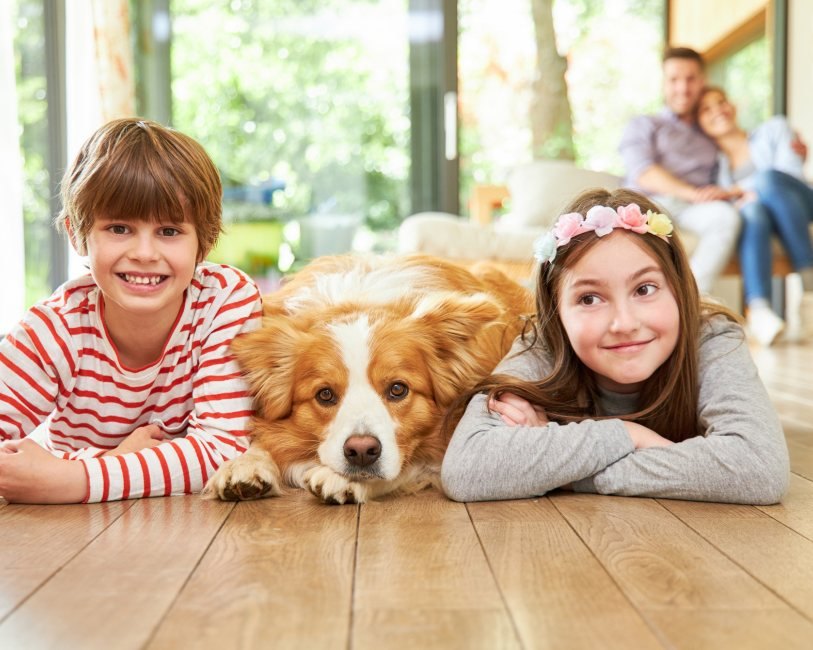
This is the whole program — Basic and Advanced, Parts 1 and 2, twelve units over twelve months. It starts with a dog who may not yet look at you when you say their name, and ends with a dog who settles on a mat when the doorbell goes, finds a hidden toy by scent, greets a visitor politely and takes a bow. All of it taught as games, filmed with our kid trainers, for families with children ages 5 to 12.
Unit 1
Introduction & getting your dog’s attention
Your dog learns to look at you when you say their name — the skill everything else is built on.
20-page activity guide · Introductions for parents and for children · Learning about your dog: whole body · Loving your dog: helping them feel safe · How to give your dog a treat · Training tool: treat pouch · Games: Doggie Yo-Yo, Magic Hands, Say My Name, Hide and Seek, Magic Hands Advanced · TTouch: introduction, Noah’s March, Llama
Unit 2
Sit
Sit on cue, then sit without being asked: at the door, before dinner, before a fuss.
16-page activity guide · Learning about your dog: mouth · Loving your dog: does my dog like to be petted? · Training tool: Halti harness · Games: Doggie Ping Pong, Let’s Sit Parts 1–3, Treats On a Seat, Sit Treat Repeat, Sit For Everything · TTouch: Tiger, Chimp
Unit 3
Come when called & down
Coming back when you call, even away from something good. And lying down on cue.
16-page activity guide · Learning about your dog: eyes · Loving your dog: dog-proofing your home · Training tool: 4- and 6-foot leashes · Games: Come for Good Stuff, Come Away From Good Stuff, Catch and Release, Down Treat Repeat, Advanced Hide and Seek · TTouch: Raccoon, Raccoon on Feet
Unit 4
Walking together inside
Loose-leash walking indoors first, where it’s quiet enough for your dog to get it right.
16-page activity guide · Learning about your dog: ears · Loving your dog: playing mental games · Training tool: how to stuff a Kong · Games: Walk This Way, Walk Together, Three’s Company, Moving Down Treat Repeat Parts 1–2, Advanced Hide and Seek 2 · TTouch: Ear Slides, Zig Zag
Unit 5
Leave it & walking outside
Leave it starts to mean leave it — and the leash walking moves out of the front door.
16-page activity guide · Learning about your dog: tails · Loving your dog: keeping your dog healthy · Games: Leave It Parts 1–2, Down Treat Repeat Part 3, Walk This Way Outside Advanced · TTouch: Jellyfish, Tail Work
Unit 6
Stay, leave it & down
Staying put while you walk away, and holding a leave it around real temptation.
16-page activity guide · Games: Down And Stay, Leave It Parts 3–4, Penalty Yards On The Road, Come When Called Toy Challenge · TTouch: Zoom Groom brush, Noah’s March with the Zoom Groom
Unit 7
Go to your mat, down & leave it
A mat your dog goes to and settles on while the rest of the household carries on.
12-page activity guide · Learning about your dog: canine calming signals · Loving your dog: keeping your dog’s teeth clean · Games: Chillax On The Mat Part 1, Come When Called Food Bowl Challenge, Leave It — The Oops Game, Super Sits, Daring Downs · TTouch: Mouth Work, Turtle
Unit 8
Go to your mat, down & tricks
SAFEHow to be safe around a dog you don’t know. Plus crawl and roll over.
12-page activity guide · SAFE: Be SAFE Around Strange Dogs, Keeping Kids SAFE Around Dogs, printable SAFE game · Loving your dog: healthy food and treats · Games: Chillax On A Mat Part 2 (go to your mat), Guess What’s Next, The Oops Game Part 2 · Tricks: Crawl, Flop & Roll Over · TTouch: Springbok, Clouded Leopard
Unit 9
Drop it, tricks & come
SAFEWhy even a family dog can bite, and how to be safe with dogs you know.
8-page activity guide · SAFE: Be SAFE Around Dogs You Know, Even Family Dogs Can Bite, printable SAFE game · Loving your dog: making sure your dog has proper ID · Games: Chillax On A Mat (down on a mat), Grocery Bag Relay, Drop It, Come When Called Leash Walk Challenge · Tricks: Shake Paws · TTouch: Hair Slides, Python Lift
Unit 10
Stay, target & the front door
Touching a target on cue, and not bolting the moment the front door opens.
12-page activity guide · Learning about your dog: how animal services helps my community · Loving your dog: helping your local animal shelter · Games: Basic Targeting, Moving Target, Come When Called Front Door Challenge, Chillax On The Mat (stay on the mat) · Tricks: Spin · TTouch: Inchworm, Tarantula Pulling The Plow
Unit 11
Wait, nosework & the doorbell
Waiting for the food bowl and at the door — and finding things by scent.
12-page activity guide · Learning about your dog: sense of smell · Loving your dog: playing nosework games · Games: Nosework Box Game, Find Your Best Friend, Wait For The Food Bowl, Wait At The Door, Chillax On The Mat Part 5 (doorbell settle) · TTouch: Jellyfish Jiggle with the Zoom Groom, Lick Of The Cow’s Tongue
Unit 12
Tricks, meet and greet & nosework
Meeting a new person or a new dog politely, out on a walk and at your own front door.
12-page activity guide · Learning about your dog: canine cognition · Loving your dog: being an advocate for your dog · How to meet a new dog · Games: What’s Under The Cup Pup?, Meet And Greet On A Walk, Meet And Greet At The Front Door · Tricks: Take A Bow, Sit Pretty · TTouch: Abalone
The units all run the same way, so your family gets into a rhythm by about month two. Each one opens with a printable activity guide, then a short Learning About Your Good Dog video about a part of your dog — ears, eyes, tail, mouth — and what it tells you about how they feel. Loving Your Good Dog covers care; Teaching Your Good Dog sets up the month’s skill. Then come the training games, each filmed with our kid trainers and each paired with its own printable training card, and the month closes with Tellington TTouch relaxation exercises you can use any time.
After unit 12 there’s a bonus unit on how to meet a new dog, a short conclusion, a course evaluation and a certificate of completion for your child. Your access doesn’t end with it — the videos, guides and cards stay open, and most families go back through the games more than once.
Right after you buy, we’ll email you an invitation to create a password and log in to our online learning system, where your program is waiting. Nothing is mailed, and nothing is scheduled — the whole program is open from day one and stays open.
These exercises are built for children ages 5 to 12, and every one of them should be actively supervised by an adult. Children should be supervised around any dog, including a family dog they have known for years.
This is not an instant fix. Every dog learns at their own pace, and repetition and consistency are what get results — we suggest five to ten minutes at a time, once or several times a day. The program does not address aggressive or fear-based behavior, which needs a reward-based dog training professional working with you in person.